For anyone who has just been cheated online
Tell it once.Know what to do next.
Kavach turns one verified account into a source-backed action plan: urgent reporting, evidence, official-channel drafts and follow-up—without pretending anything has been filed.
Check a message firstTry the live demo
Independent tool. Not a government website.
What Kavach actually does
You speak
Just talk. That is the whole form.
…a transaction day before yesterday, which got failed.
22 Indian languages + English
A voice interview in any of 23 languages, with live captions as it listens. No forms, no OTP, no captcha.
The scale
This is not a rare thing that happens to careless people.
One portal took twenty-four lakh complaints in 2025 alone. The money behind them is not a rounding error, and a quarter of it was taken from the people least equipped to chase it.
24 lakh
cybercrime complaints on the portal in 2025
₹22,495 cr
reported lost in that one year
5.66 lakh
of those complaints came from senior citizens and women
₹7,769 cr
the money behind just those
Calendar year 2025, from the Ministry of Home Affairs' own answer to the Lok Sabha — the National Cyber Crime Reporting Portal and the Citizen Financial Cyber Fraud Reporting and Management System, both run by the Indian Cyber Crime Coordination Centre.
Read the answer: Ministry of Home Affairs, Lok Sabha answer, 2 December 2025I tried four times to register a complaint. After five minutes the portal threw me out. No complaint means no fraud, as far as the government is concerned.
Siddhartha M., on LinkedIn
After the first page the site stopped responding. Refreshing asked for OTPs again. Eight attempts, still nothing filed.
Deep D., product manager, on LinkedIn
The OTP does not come and the site freezes in the middle. I have been trying for seven hours.
Reddit, r/india
Where it breaks today
The reporting works. The reporting form is what people lose.
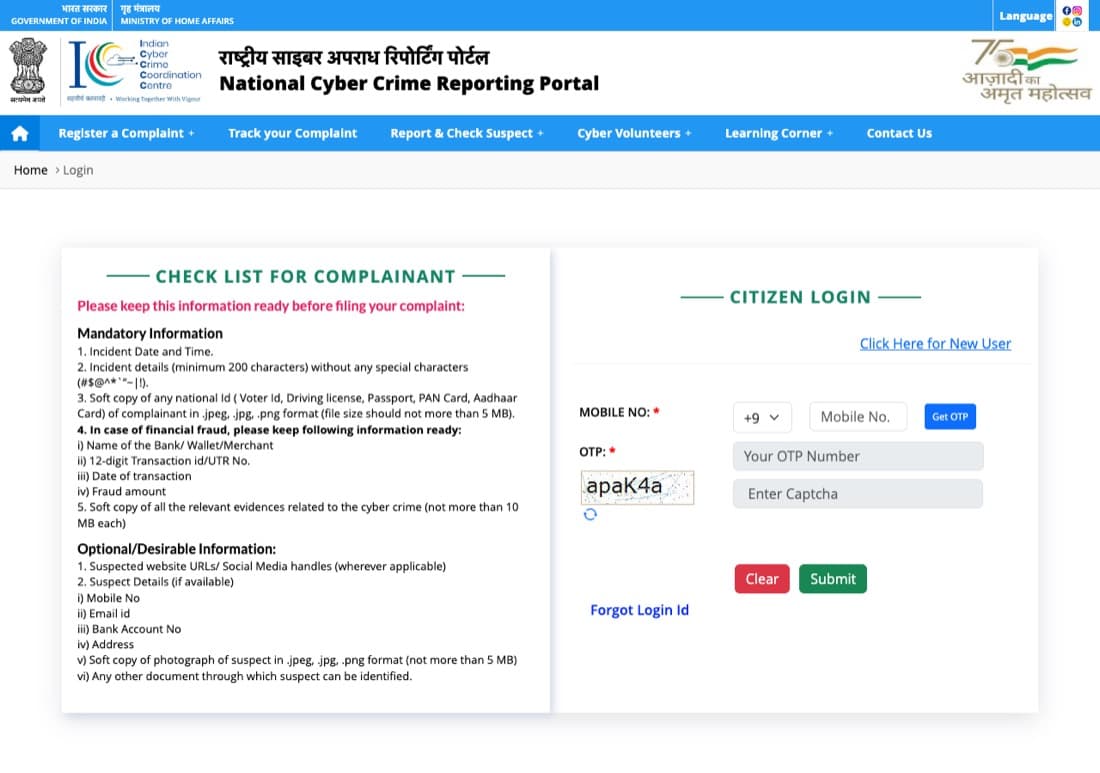
Every claim here is from the Ministry of Home Affairs’ own Citizen Manual or the checklist printed on the portal’s login page. We are not guessing at the current experience — it is documented, by the people who built it.
16
fields the portal will not submit without
30
minutes before its OTP expires
13
of those we do not block on
The first and third are counted from the field schema this prototype actually implements, so they change when it does. The thirty minutes is the portal's own figure, from the Ministry of Home Affairs' Citizen Manual.
- 01
The OTP expires in thirty minutes. The form is forty fields with no autosave. We save every keystroke as you type.
- 02
It asks who you are before it asks what happened. We ask last, once the complaint is already written.
- 03
Its only edit button on the review screen wipes the form. Ours changes one answer and keeps the rest.
What this comparison is not
The portal does things we do not. It routes complaints to the relevant state or UT law-enforcement agency, issues an acknowledgement, and connects financial-fraud reports to participating institutions through CFCFRMS so they can attempt action on the money trail. An acknowledgement is not an FIR, a hold is not a refund, and neither outcome is guaranteed. Nothing here submits to a government system. This is a demonstration of a safer filing experience, built to be handed over—not an accusation against the people who operate the portal.
What we built instead
Four things that are hard to bolt on afterwards.
Not features. Each one had to be decided before the first line was written, which is why a portal cannot add them in a release.
23
Languages, end to end
Not a translated interface. The voice interview, the extraction, the drafts and the deadlines all run in every scheduled language of India, and in English. Retrofitting that means rebuilding the intake, not adding a dropdown.
10
Tracks, each carrying its source
Every deadline we show names the rule it comes from — RBI, BNSS, the Citizen Manual — links to it, and re-fetches that link every week. A system that cannot say where a date came from cannot start saying it later.
0
Forms before you may speak
You talk in the order it comes out, ungrammatically, in two languages at once, and a structured case comes out. The portal needs sixteen fields before it will accept a word about the crime.
—
Things we pretend are filed
Kavach prepares and never submits. Nothing is marked done until an official channel returns a real receipt. Every product in this space is tempted by the opposite, and it is the one thing a victim cannot afford us to get wrong.
- English
- हिन्दी
- বাংলা
- मराठी
- తెలుగు
- தமிழ்
- ગુજરાતી
- اردو
- ಕನ್ನಡ
- ଓଡ଼ିଆ
- മലയാളം
- ਪੰਜਾਬੀ
- অসমীয়া
- मैथिली
- ᱥᱟᱱᱛᱟᱲᱤ
- کٲشُر
- नेपाली
- سنڌي
- डोगरी
- कोंकणी
- ꯃꯤꯇꯩꯂꯣꯟ
- बर’
- संस्कृतम्
Every one of these is a scheduled language of India. Pick yours in the bar above.
The proof
One real call, and the case it became.
The recording, the transcript and the fields the model filled, committed to this repository. Check the extraction against what was actually said.
A real call
The caller answered in Hindi. It caught the name, used it, and filled the form.
This is not a mock-up. It is a recorded call with Kavach Saathi, played back exactly as it happened — a ₹10,000 card payment that failed two days earlier, and a stranger still demanding the money by email. The caller never typed a word, never chose a category, never saw a form.
- median reply
- 1.6s
- facts captured
- 10
- languages, one number
- 23
- form fields to fill
- 0
median reply
facts captured
languages, one number
form fields to fill
- It answers in about a second and a half, so nobody is left talking into silence.
- It asked what to call them, heard “प्रणव” in Hindi, and used the name for the rest of the call.
- It sent the caller to 1930 and their bank in its second breath, before asking anything else.
- Nothing here was filed with anyone. The call says so out loud, and so do we.
Listen to the call
Recorded with consent for this demonstration. Names and identifiers are the caller's own test data.
What was said
- Kavach Saathi: Hello, I am Kavach Saathi, an AI assistant from Kavach — not the police or government, Please tell me what happened,
- Caller: I am facing a online fraud that I have did a transaction day before yesterday, which got failed. But then the person in front is asking me again for the money. It was around 10000 rupees, 2 days back.
- Kavach Saathi: I am sorry to hear that. First, what may I call you?
- Caller: प्रणव,
- Kavach Saathi: Thank you, Pranav. Since this happened very recently, please call 1930 and your bank's fraud number as soon as this call ends, or right now if you prefer. To help me understand, how did you try to send this 10,000 rupees—was it through an app, a card, or
- Caller: भाई,
- Caller: Sorry, buy card.
- Kavach Saathi: Got it, Pranav. You tried to send the money by card. Did you receive any transaction reference number or message when the transaction failed?
What it filled in, on its own
Every value below was taken from the conversation above. Nothing was typed.
- What to call them
- Pranav
- Money moved
- No
- When
- 2026-09-03
- Possible category
- Online payment fraud/phishing
- Amount lost
- ₹10,000
- Paid through
- Card
- How it was authorised
- failed
- Evidence held
- Screenshots of the failed transaction
- What they want
- Recover the money
- Told to call 1930
- Yes
Two minutes, start to finish.
One prototype run: a citizen describes a fraud, verifies the extracted facts and leaves with an unfiled case plan and clearly labelled drafts.
The line
What is real here, and what is pretend.
A prototype, with no relationship to the Government of India, that cannot submit anything for you. Here is the exact line.
Real and working
- Voice and text intake in 23 languages
- AI classification against the official NCRP category tree
- Extraction of UPI IDs, UTRs, accounts, phones and amounts from pasted evidence
- Ten action tracks, with conditional RBI screening and source provenance
- Generated NCRP text, bank dispute letter, FIR application and 1930 script
- Downloadable PDF case pack, and the case file surviving a closed browser
- Cases stored in Postgres and reopened on another device from their own link
- Signed-in cases follow the same login across devices, and a call's transcript stays saved with its case after the recording expires
- Classification is scored against a published set of cases before any change to the model, the prompt or the category tree ships
- Every legal citation on this site is fetched automatically each week, so a moved circular is found by us rather than by somebody relying on it
Mocked on purpose
- Nothing is submitted to cybercrime.gov.in. You copy the text across yourself
- Complaint status and police-station routing are simulated, not fetched
- Kavach never asks for an OTP, password, bank login, Aadhaar or PAN. Do not enter them in your story or evidence notes.
- Reference numbers are generated locally and are not government numbers
- An account gets you in, but it is not what holds your case: a case is held by whoever has its link, so losing the link loses the case and sharing the link shares everything in it
If this were real
Kavach sits beside the portal, not in place of it. At scale it would submit through an authenticated I4C integration instead of asking you to copy text across.